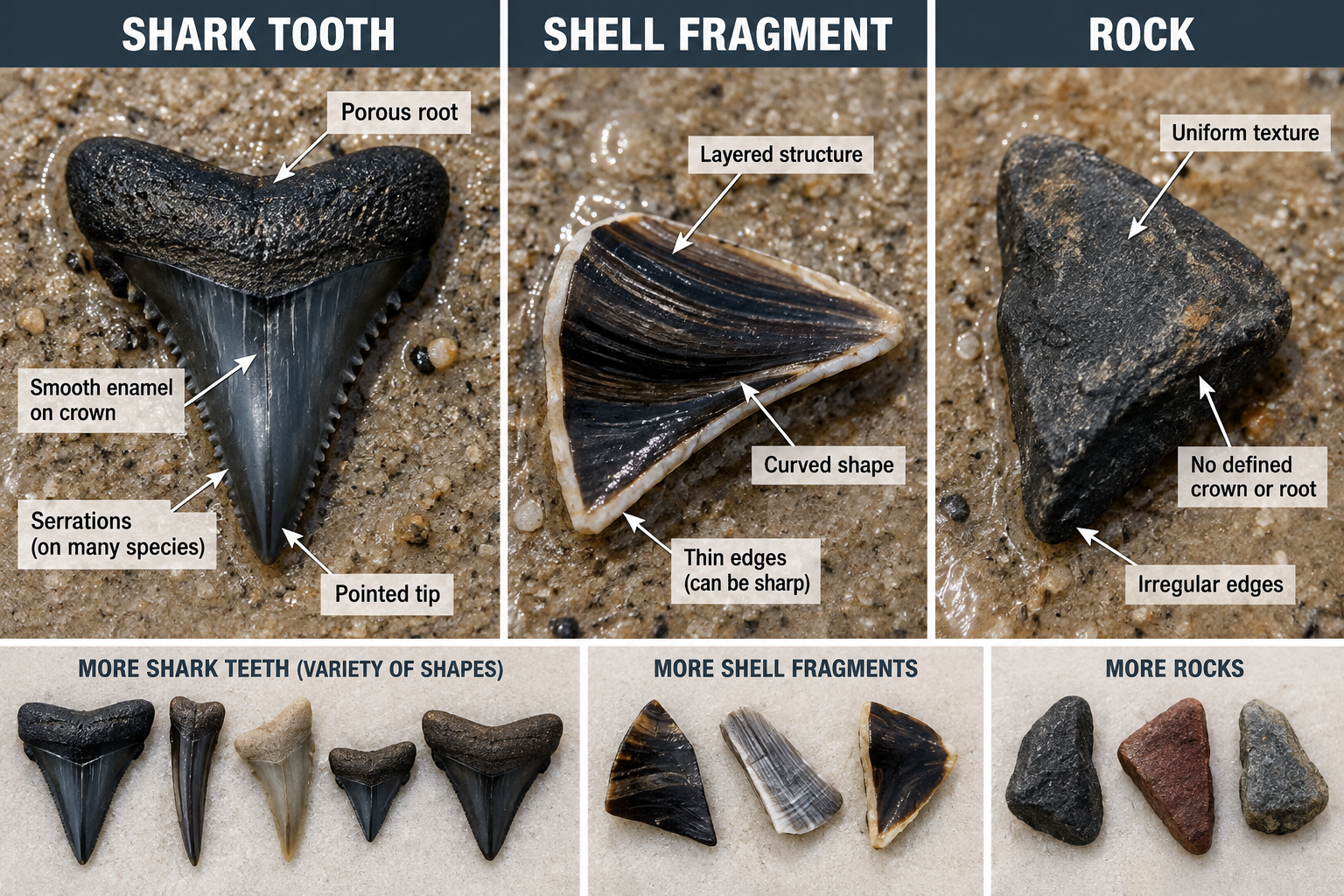
When you first start hunting for shark teeth, nearly every dark triangle in the sand can look promising. Pieces of shell, small rocks, and other fragments can all have the right color or shape to make you stop and pick them up.
The trick is learning that there isn't one feature that proves you've found a shark tooth. Instead, look for a combination of shape, enamel, edges, and root structure. Once you know what those features look like, telling teeth from lookalikes becomes much easier.
1. Look for a Distinct Crown
Start with the overall structure of the object.
The crown is the part of the shark tooth that was exposed above the gumline.
Depending on the species, it might be broad and triangular, long and narrow, curved, or relatively flat.
What matters isn't finding a perfect triangle. Look for a distinct crown with edges that come together to form a recognizable point or cutting surface.
Broken shells and rocks can certainly be triangular, which is why shape should only be your first clue—not your final answer..
2. Look Closely At The Enamel
The crown of a shark tooth is covered in hard enamel, which usually gives it a relatively smooth surface that can appear glossy or reflective, particularly when wet.
But here's where beginners can easily be fooled: shells can be smooth and shiny too.
Instead of asking only, "Is it shiny?" look at how that smooth surface relates to the rest of the object. On a shark tooth, the enamel forms a defined crown with recognizable edges. If the root is preserved, you'll often see a noticeable transition from the smoother crown to the rougher material above it.
A shiny surface is a clue. Shine plus tooth-like structure is much stronger evidence.
3. Check For a Root
The root is often the feature that makes a questionable find much easier to identify.
It sits at the base of the crown and generally looks quite different from the enamel. Fossil shark tooth roots typically have a rougher, more porous texture, and on many teeth the root extends outward to either side of the crown.
This creates one of the most useful combinations to look for: Smooth enamel crown + distinct porous root
Shell fragments generally don't have this clear change from enamel-like crown to porous root. Rocks won't either.
Of course, the root isn't always there. It's common to find teeth with damaged or completely missing roots.
4. Examine the Cutting Edges
Next, look along the sides of the crown.
Some shark teeth have tiny serrations, creating a saw-like cutting edge. Others have completely smooth edges depending on the species.
Don't assume that every shark tooth needs serrations. Instead, look for edges that appear to be part of the tooth's original structure rather than the irregular edge of something that simply broke into a triangular shape.
If serrations are present, however, they're an excellent clue that you're looking at a tooth.
5. Look at the Whole Object
This is the most important habit to develop.
Don't identify something as a shark tooth because it's black, triangular, or shiny. All three characteristics can occur in things that aren't shark teeth. Shark teeth can actually be found in a variety of colors depending on the conditions in which they fossilized.
Instead, ask whether the features work together.
Quick Tooth Checklist
When you're unsure about a find, check for:
• A recognizable crown
• Smooth or glossy enamel
• Defined cutting edges
• Serrations on species that have them
• A separate, rougher or porous root
• An overall structure consistent with a tooth rather than a broken fragment
A complete tooth may show nearly all of these characteristics. A worn or broken tooth might only show a few..
Rock, Shell, or Tooth?
Shell fragments are probably the easiest lookalikes to mistake for teeth. They can be triangular, dark, smooth, and surprisingly shiny. Look for shell-like layering, curvature, or broken edges rather than a distinct crown and root.
Rocks and mineral fragments can also break into convincing shapes, but they generally lack the organized structure of a tooth. A triangular rock without a defined enamel crown, cutting edge, or root is probably just that—a triangular rock.
A shark tooth, on the other hand, usually has multiple features working together. Even when part of the tooth is missing, you can often recognize some combination of the crown, enamel, cutting edge, serrations, or root.
You'll Get Better Quickly
In the beginning, you'll probably pick up plenty of shells and rocks that turn out to be false alarms. That's part of learning.
After you've found and handled a few real shark teeth, you'll begin noticing subtle differences in their shape and texture. Eventually, your eyes start recognizing those characteristics before you've even picked the tooth up.
If you're ready to put that recognition into practice, learning where and how to scan for shark teeth on the beach or how to hunt for shark teeth in Lowcountry creeks is a good next step.
Until then, don't be afraid to pick up the questionable ones. Learning what isn't a shark tooth is one of the best ways to get better at recognizing what is.