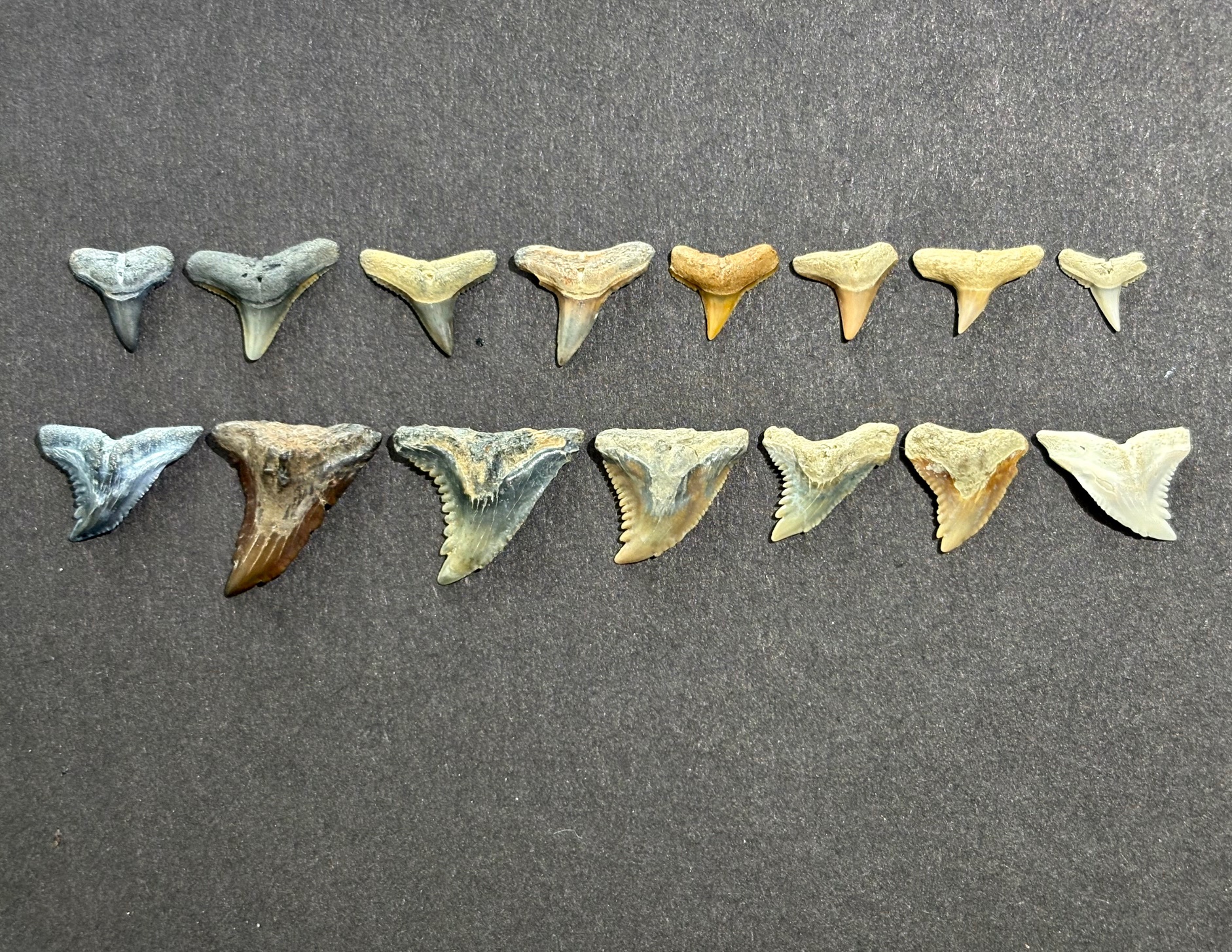
If you ever find a handful of fossil shark teeth along the South Carolina coast, there’s a good chance they don’t all look the same.
Many are the familiar glossy black that fossil hunters learn to spot. But others may be gray, brown, tan, reddish, blue-gray, or even surprisingly light in color.
So why the difference?
The short answer is geology. A fossil shark tooth’s color is largely influenced by the sediment, groundwater, and minerals surrounding it during and after fossilization. In fact, two teeth shed by the very same shark could eventually fossilize into completely different colors if they were buried in different environments.
Shark Teeth Don't Start Out Black
Modern shark teeth are generally white or cream-colored. The darker colors we associate with fossil teeth develop after a tooth is shed and becomes buried. Sharks continually replace their teeth throughout their lives, shedding thousands of them. If a shed tooth settles onto the seafloor and is buried quickly enough, sediment can protect it from being destroyed by waves, currents, and other natural processes.
Once buried, the tooth begins a long process of chemical change.
Water moving through the surrounding sediment carries dissolved minerals. Over time, minerals can enter tiny spaces within the tooth and chemical changes can occur within its original mineral structure. This process helps preserve the tooth while also changing its appearance. The Florida Museum of Natural History describes fossil shark teeth as being preserved through permineralization, with the minerals in the surrounding sediment playing an important role in their eventual color.
Different Minerals Create Different Colors
Think of the sediment surrounding a buried tooth as its chemical environment. A tooth buried in one layer of sediment may encounter a different mix of minerals than a tooth buried somewhere else. Iron, manganese, silica, calcite, and other minerals and elements can all be involved in the fossilization process. Iron is an easy example. When iron oxidizes, it can produce reddish or brown coloration—the same basic chemistry responsible for rust. The Florida Museum also notes that iron, manganese, and other elements can replace some of the calcium within fossil material and contribute to color changes.
The result is the surprisingly broad range of colors fossil hunters encounter. A tooth's crown and root can even be different colors. The hard outer enameloid of the crown is already highly mineralized when the shark is alive, so it can react differently during fossilization than the more porous material inside the tooth and root.
Which Minerals Create Which Colors?
There isn't a perfect color chart for fossil shark teeth because several minerals and chemical conditions can influence a tooth at the same time. Still, certain colors are commonly associated with particular elements.
Iron is especially important. Iron compounds can give fossil teeth shades of red, orange, yellow, and brown, depending on their chemical state and the conditions in the surrounding sediment. Manganese compounds are commonly associated with very dark brown and black coloration.
Other minerals, including silica and calcite, can fill microscopic spaces within a buried tooth during fossilization, while the overall chemistry of the sediment and groundwater influences its final appearance.
This is why it's difficult to look at a gray, blue, tan, or black shark tooth and say that one particular mineral created its color. The tooth's appearance is better thought of as the result of its entire burial environment, rather than a single ingredient.
Why Are So Many South Carolina Shark Teeth Black?
Black and dark gray teeth are especially common finds in the Lowcountry. That makes sense given the area's geology. Coastal South Carolina contains extensive marine deposits, including historically important phosphate-rich formations and sediments containing shark teeth and other marine fossils.
But it's important not to simplify this into "phosphate makes shark teeth black." Fossil color can reflect a combination of the minerals and elements present, groundwater chemistry, oxidation conditions, and changes that occurred during a tooth's long history underground. That's also why you shouldn't ignore a tooth simply because it isn't black.
Does a Darker Tooth Mean It's Older?
Not necessarily.
This is one of the most useful things for beginner fossil hunters to understand.
Color is not a reliable fossil clock. A black tooth isn't automatically older than a tan tooth, and a light-colored tooth isn't automatically recent. Fossils of different ages can develop similar colors, while fossils of similar ages can look very different depending on the sediments in which they were preserved.
Paleontologists generally determine the age of a fossil shark tooth by studying the geologic layer it came from, along with other fossils and geological information associated with that layer—not simply by looking at its color.
There is another complication for beach and creek hunters: fossils can be reworked. A tooth may erode out of the sediment where it originally fossilized, get transported by water, become buried again, and eventually erode out somewhere else. Some fossil teeth have probably gone through multiple cycles of burial, exposure, and transport before you ever pick them up.
Every Color Tells Part of a Geological Story
The next time you find a shark tooth that is brown instead of black—or gray, tan, reddish, or blue-gray—don't assume something is wrong with it. That color is part of the fossil's history.
A shark may have shed the tooth millions of years ago, but the appearance you see today was shaped by what happened afterward: where it was buried, what minerals surrounded it, how groundwater moved through the sediment, and what happened as those sediments changed over time.
So when you're scanning a South Carolina beach or creek bed, look for the shape of a shark tooth first—not just the color black. You might be surprised by what you've been walking past.