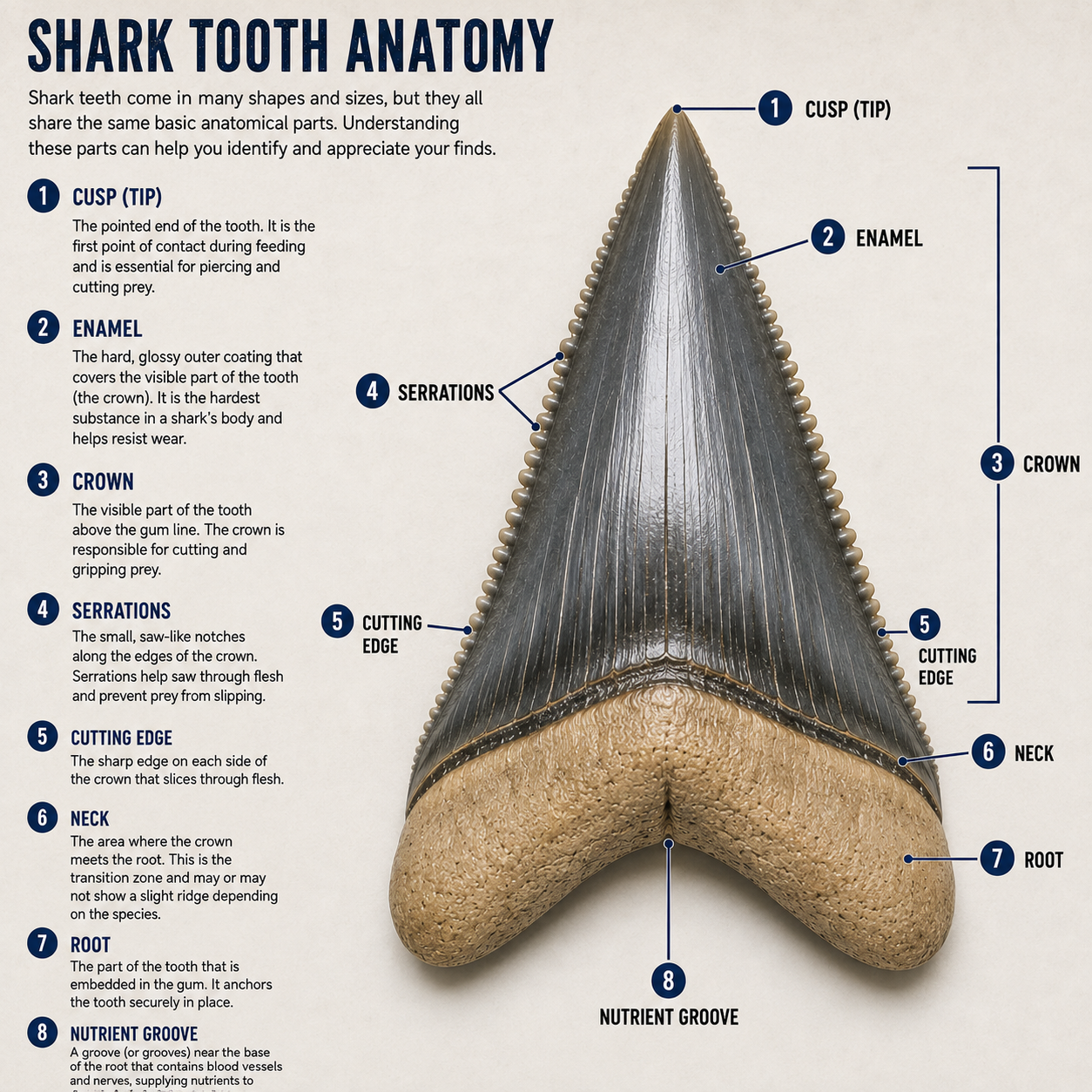
If you spend enough time hunting for fossilized shark teeth, you'll quickly notice that they don't all look alike. Some are broad and triangular, others are long and narrow, and some have obvious serrations while others have perfectly smooth edges. Despite these differences, most shark teeth share the same basic anatomy. Learning these parts can make it easier to describe your finds, identify different species, and understand how a tooth was originally used.
Crown
The crown is the upper portion of the tooth and the part primarily responsible for interacting with prey. On a complete fossil shark tooth, it's usually the smooth, often glossy portion extending upward from the root.
The crown is covered by an extremely hard outer layer called enameloid. This protects the tooth and helps it withstand the forces involved in grabbing, cutting, and tearing prey.
Crown shape is also one of the most useful characteristics for shark tooth identification. Depending on the species and the tooth's position within the mouth, crowns may be broad and triangular, narrow and needle-like, curved, or nearly straight.
Cusp
The cusp is the pointed portion of the crown. On many shark teeth, particularly the triangular teeth commonly found along the South Carolina coast, the main cusp forms the prominent point that most people immediately recognize as the "tip" of the tooth.
Some species also have smaller secondary cusps, commonly called cusplets, positioned alongside the main cusp. These can be particularly helpful when identifying certain fossil shark species.
Cutting Edges and Serrations
Running along either side of the crown are the cutting edges. Depending on the species, these edges can either be smooth or covered in tiny serrations.
Serrations are the small, saw-like structures visible along the cutting edge of teeth from sharks such as the great white and megalodon. They helped the shark slice through prey more efficiently.
Not every shark tooth has them. Other species have smooth cutting edges, reflecting differences in diet and feeding strategy.
Serrations can also be useful for identification, so it's worth looking closely before assuming a worn fossil tooth was originally smooth.
Neck
The neck is the transitional area where the crown meets the root. Depending on the species, this area can look quite different and may provide an important clue when identifying a fossil shark tooth.
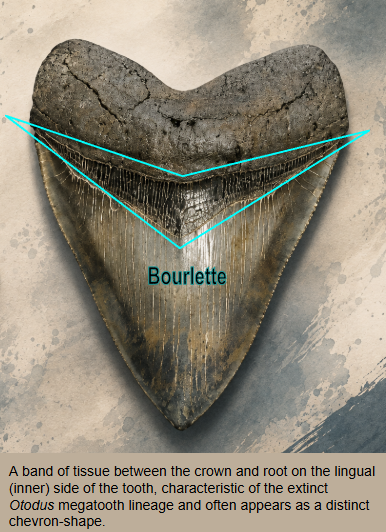
Some teeth have a distinct band of exposed dentine between the crown and root called a bourlette. Megalodon teeth are a well-known example. On a well-preserved megalodon tooth, the bourlette often appears as a contrasting band just below the enamel-covered crown and above the root.
Most shark teeth, however, do not have a bourlette. For example, Carcharodon hastalis—an extinct shark whose teeth can resemble unserrated great white teeth—lacks this feature. Modern great white teeth also lack the prominent bourlette associated with megalodon and its close relatives.
Because the presence, absence, and appearance of this area vary among sharks, it's another useful feature to examine when identifying a fossil tooth.
Root
The root forms the base of the tooth. Unlike human teeth, shark teeth aren't anchored directly into jawbone. Instead, they are held within connective tissue and are continually replaced throughout the shark's life.
The root is generally less glossy and more porous-looking than the crown. A complete root can be extremely helpful for identification because its shape, width, lobes, and overall proportions differ among species.
Unfortunately for fossil hunters, roots are also commonly damaged or completely missing.
Nutrient Groove
On the root of some shark teeth, you'll notice a small groove running vertically through its center. This is commonly called the nutrient groove.
It is associated with the vascular supply to the developing tooth and can vary significantly in size and prominence between different types of shark teeth.
Anatomy Can Help Identify Your Finds
When identifying a fossilized shark tooth, don't focus only on its overall shape. Look at the individual anatomical features.
Is the crown broad or narrow? Are the cutting edges serrated or smooth? Are there cusplets? What shape is the root? Is a nutrient groove visible?
Those small details can turn an unidentified triangular object into something much more interesting—and learning to recognize them is one of the best ways to become better at identifying the shark teeth you find.