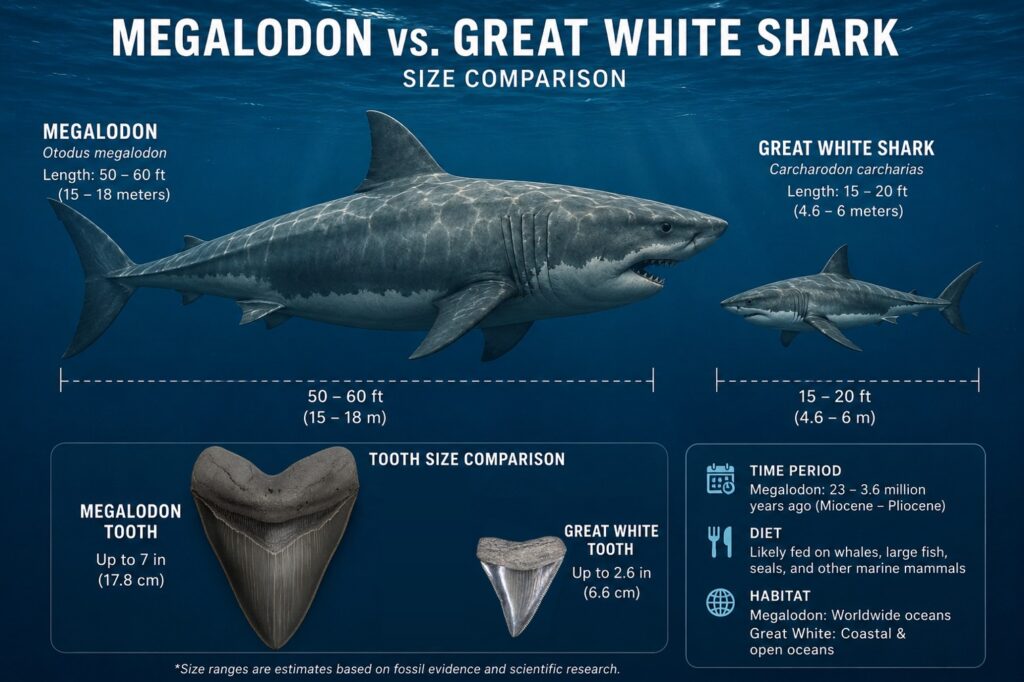
Finding a megalodon tooth is one of the most exciting moments for any fossil hunter. Even if you've seen photos online, it's hard to appreciate just how massive these fossils are until you're holding one in your hand. So, how does a megalodon tooth compare to the teeth of sharks swimming in today's oceans? The difference is actually very remarkable!
Megalodon Teeth Could Grow Over 7 Inches Long
Megalodon (Otodus megalodon) is the largest shark known to have ever lived. Although its skeleton was made mostly of cartilage and rarely fossilized, its teeth have survived by the thousands because shark teeth fossilize extremely well. Because sharks constantly shed and replace their teeth, these fossils are one of the best clues scientists have for understanding this prehistoric giant. The largest known megalodon teeth measure more than 7 inches (18 cm) from the tip of the crown to the bottom of the root. Most complete teeth found by collectors are smaller, usually 3.5 to 5 inches, while anything over 6 inches is considered an exceptional find. For comparison, a 7-inch tooth is about the length of an adult's hand.
How Do Megalodon Teeth Compare to Modern Sharks?
The great white shark is often compared to megalodon because both have broad, triangular, serrated teeth built for cutting through large prey. But when you put the teeth side by side, the size difference is obvious.
Shark Species
Typical Tooth Size
Maximum Tooth size
Sand Tiger Shark
0.5-1 inch
About 1.5 inches
Bull Shark
Around 1 inch
About 1.5 inches
Tiger Shark
1-2 inches
Around 2.5 inches
Great White Shark
1.5-2.5 inches
About 3 inches
Megalodon
3.5-5 inches
Over 7 inches
Even the largest great white tooth is less than half the size of the biggest known megalodon teeth.
Why Were Megalodon Teeth So Big?
The answer is simple: megalodon hunted enormous prey. Scientists believe it fed primarily on whales, dolphins, seals, and other marine mammals. Its thick, heavily serrated teeth were designed to slice through blubber, muscle, and bone. Compared to the teeth of modern sharks, megalodon teeth are not only longer but also much broader and more robust. Like today's sharks, megalodon continuously replaced its teeth throughout its life. Over a lifetime, a single shark likely shed thousands of teeth, which explains why fossil teeth are much more common than fossil skeletons.
How Big Was Megalodon?
Since sharks have cartilage instead of bone, complete skeletons rarely fossilize. Instead, scientists estimate megalodon's size by comparing its teeth and vertebrae with those of living sharks. Current research suggests the largest individuals reached about 65 feet (20 meters) in length. Here's how that compares to some familiar sharks:
• Great White Shark: 15–20 feet
• Tiger Shark: 10–16 feet
• Bull Shark: 7–11 feet
• Whale Shark: Up to about 60 feet
• Megalodon: Up to about 65 feet
While the whale shark can approach megalodon in length, the two lived very different lifestyles. Whale sharks are gentle filter feeders, while megalodon was an apex predator that hunted some of the largest animals in the ocean.
Can You Find Megalodon Teeth in South Carolina?
Yes—and South Carolina is one of the best places in the United States to find them. Millions of years ago, much of the state was covered by warm, shallow seas. Learn how South Carolinas ancient seas created today's fossil-rich landscape. As ancient marine sediments erode today, fossil shark teeth are released from the surrounding rock and can eventually be found along beaches (especially when conditions are right), rivers, and tidal creeks. Most megalodon teeth discovered in South Carolina measure between 3 and 5 inches. Teeth larger than 6 inches are uncommon, making them prized finds among collectors.
Why Are Large Megalodon Teeth So Rare?
Not every megalodon had a 7-inch tooth. The biggest teeth came from the largest (and likely oldest) individual sharks. Those sharks were naturally less common, and their teeth have spent millions of years buried before being exposed by erosion. Once exposed, waves, river currents, and shifting sediments can chip, crack, or wear them down. That's why finding a complete tooth over 6 inches long is so rare.
Final Thoughts
A great white shark tooth is one of the largest you'll find from a living shark. Place it beside a megalodon tooth, and the size difference is mind boggling. Those oversized teeth are more than just collectibles- they're evidence of a shark that may have reached 65 feet in length and ruled the oceans until about 3.6 million years ago. If you ever find a megalodon tooth along the South Carolina coast, you're holding a fossil from one of the largest predators our planet has ever known. It's a tangible connection to an ancient ocean that once covered the Lowcountry.