Every fossilized shark tooth tells an incredible survival story. While sharks have shed countless trillions of teeth over the past several millions of years, only an extraordinarily small fraction escaped destruction and became fossils. Understanding how that happened helps explain not only how fossilization works, but also why shark teeth are among the most common fossils found today! Contrary to popular belief, a shark tooth doesn't simply lie on the ocean floor for millions of years until it "turns to stone." The most important steps in fossilization occur shortly after the tooth is shed, when its fate is determined by the environment around it.
How a Shark Tooth Becomes a Fossil
The moment a shark sheds a tooth, its survival depends almost entirely on its environment. If the tooth remains exposed on the seafloor, waves, currents, abrasion from sand and shell fragments, and chemical weathering gradually wears it down until it breaks apart or dissolves. Most shark teeth never survive this stage. The teeth that do survive are usually buried quickly beneath sediment. This rapid burial is the single most important step in fossilization. Once covered, the tooth is protected from physical damage and isolated from many of the biological and chemical processes that would otherwise destroy it. Burial also reduces oxygen levels, limiting biological activity and creating a more stable environment for preservation. Over hundreds to thousands of years, water carrying dissolved minerals moves through the surrounding sediment. These minerals gradually fill microscopic spaces within the tooth and may replace some of its original material while preserving its shape. Paleontologists refer to these processes as permineralization and mineral replacement. There is no precise moment when a buried tooth suddenly becomes a fossil. Although fossilization begins soon after burial, the process generally takes hundreds to thousands of years. By the time we find fossilized shark teeth today, they are typically millions of years old. Eventually, geological processes reverse the tooth's burial. Rivers cut through ancient sediments, coastal erosion exposes fossil-bearing formations, and waves wash fossils from offshore deposits onto modern beaches. The shark teeth you find today have likely spent millions of years hidden underground before being uncovered once again. So that small black tooth you found in a South Carolina creek didn't survive simply because it was old. It survived because, shortly after falling from a shark's mouth, it escaped countless opportunities to be destroyed.
Why Teeth Fossilize Better Than Bones
If shark teeth fossilize so well, why don't we regularly find complete sharks fossils? The answer lies in what sharks are made of. Unlike mammals and most fish, sharks do not have skeletons made of true bone. Nearly their entire skeleton consists of cartilage, which is lightweight and flexible but decomposes quickly after death. Unless a shark is buried under exceptional conditions, its skeleton is usually consumed by bacteria, scavengers, and natural decay long before fossilization can occur. Shark teeth are very different. They are made primarily of highly mineralized enameloid and dentine, making them among the hardest structures in the animal kingdom. Even before fossilization begins, they are naturally resistant to wear and decay. This same principle applies to most vertebrates. Teeth generally fossilize more readily than bones because they are denser, harder, and less porous. Bones can fossilize through similar processes, but they are more susceptible to decay, weathering, and chemical breakdown before burial. One exception is shark vertebrae. Although they are not true bone, they contain heavily calcified cartilage that makes them far more durable than the rest of the skeleton. Given favorable conditions, vertebrae can fossilize alongside teeth, though they remain much less common. This is why paleontologists have identified many extinct shark species from teeth alone. In many cases, the teeth are all that remain.
Why Sharks Shed So Many Teeth
If fossilization is so rare, why are fossilized shark teeth one of the most common fossils on Earth? The answer has less to do with fossilization than with shark biology. Unlike humans, whose permanent teeth are meant to last a lifetime, sharks continuously replace theirs. Their teeth are arranged in multiple rows, with new teeth developing behind the functional row. As older teeth are lost through feeding or normal wear, replacement teeth rotate forward into position. This system gives sharks a major advantage. Their teeth frequently break, dull, or fall out while biting prey, but instead of repairing damaged teeth as us humans do, they simply grow new ones. Depending on the species, a shark may replace individual teeth every few weeks to several months. Over its lifetime, a single shark can shed 20,000 to 35,000 teeth, and some species may lose even more. Multiply that by the millions of sharks that have lived over the past several millions of years, and it's easy to see why the fossil record contains so many shark teeth. Every shed tooth is another opportunity for fossilization, even if only a tiny percentage are ever preserved.
How Rare Is Fossilization?
Although fossilized shark teeth are common, fossilization itself is anything but. Every year, modern sharks shed billions of teeth into the world's oceans. The overwhelming majority are destroyed by waves, currents, chemical weathering, or physical abrasion long before they can be buried. Others are buried only to be re-exposed and broken down over time. Only a very small percentage are buried quickly enough and under the right conditions to become fossils. Scientists cannot calculate exactly what percentage of shark teeth are fossilized because there is no way to know how many teeth have been shed throughout Earth's history or how many fossils have since been destroyed by erosion, metamorphism, or plate tectonics. While estimates of less than one percent are sometimes cited, they should be viewed as educated approximations rather than measured values. The important takeaway is that fossilization is an exceptionally rare outcome. Fossilized shark teeth seem abundant today not because preservation is common, but because sharks have been shedding enormous numbers of teeth for hundreds of millions of years.
How Long Does It Take for a Shark Tooth to Fossilize?
The answer is surprisingly different from what many people expect. A shark tooth doesn't simply lie on the ocean floor for millions of years until it "turns into stone." In fact, the most important part of fossilization happens shortly after the tooth is shed. If the right conditions aren't present, it will eventually be destroyed like the billions of other shark teeth lost in the ocean every year. Most fossilization begins within days to years after a tooth is buried, but the process of preserving it can continue for hundreds or even thousands of years. By the time we find fossilized shark teeth today, they are typically millions of years old—but that's their age, not the length of time it took them to fossilize.
How Do Paleontologists Determine a Shark Tooth’s Age?
Unlike archaeological artifacts, individual shark tooth fossils are rarely dated directly. Instead, paleontologists determine their age by dating the rock layer (geologic formation) in which the tooth was found. For example, a shark tooth recovered from South Carolina's Ashley Formation is considered approximately 27–30 million years old because that formation was deposited during the late Oligocene, not because the tooth itself was individually dated. If a tooth is found loose in a river or on a beach, its exact age may be less certain, but its color, preservation, and the local geology often allow paleontologists to identify the formation it most likely eroded from.
How Can You Tell if a Shark Tooth is Fossilized?
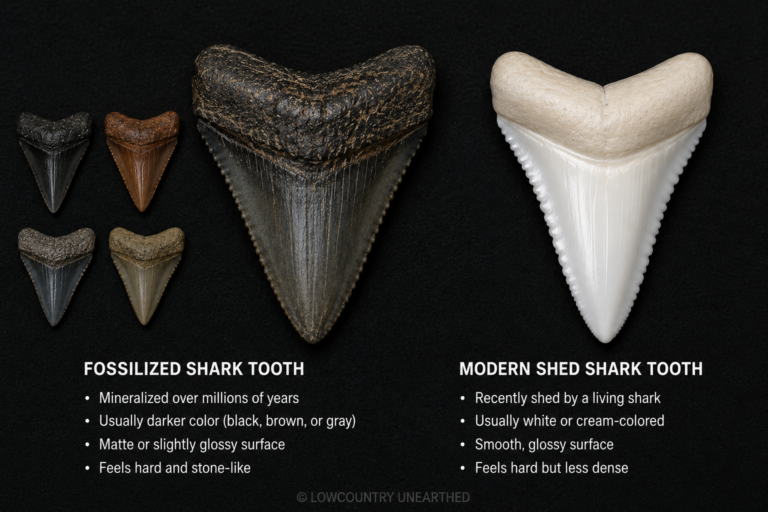
One of the easiest ways to tell whether a shark tooth is fossilized is by considering both its appearance and where it was found. Fossil teeth have undergone mineralization during burial, making them denser and often giving them a stone-like feel. They commonly appear black, brown, gray, tan, or even blue depending on the minerals present during fossilization, although color alone is not a reliable indicator. Freshly shed teeth from modern sharks are usually white or cream-colored with a smooth, glossy enamel surface and sharp, unworn cutting edges. Because they have not been buried or mineralized, they retain their original appearance rather than the darker colors and stone-like feel commonly seen in fossil teeth. In fossil-rich areas like South Carolina, shark teeth recovered from rivers, creeks, or eroding beaches are almost always fossilized, while white teeth found near modern coastlines are generally recent. Ultimately, the geologic context where a tooth is discovered is often the most reliable clue to both its age and whether it is fossilized.
Conclusion
The next time you find a fossilized shark tooth, remember that you're holding far more than a tooth that's simply "old". Its journey began the moment it was shed into an ancient ocean. To survive, it had to be buried quickly, protected from decay, preserved by mineral-rich groundwater, and remain hidden underground for millions of years before erosion exposed it once again. Most shark teeth never make it that far. Understanding this process also explains why shark teeth are among the most common fossils while complete shark skeletons are exceptionally rare. Teeth are naturally built to last, sharks produce them in astonishing numbers, and only a tiny fraction experience the conditions needed for fossilization. Every fossil shark tooth is a rare survivor. A small piece of Earth's history that has endured against remarkable odds. So, I hope with each find, you feel a deep sense of glee! And if you’ve stuck with us this far, please check out our species gallery and consider donating pictures of your finds! And as always, feel free to share photos of what you unearthed locally here – we love to showcase any and all finds around the beautiful Lowcountry!
PLEASE NOTE: The below photo was AI generated. The purpose of the photo is to give readers a general visual of what fossilized vs modern teeth look like and is not reflective of teeth actually found in the field.