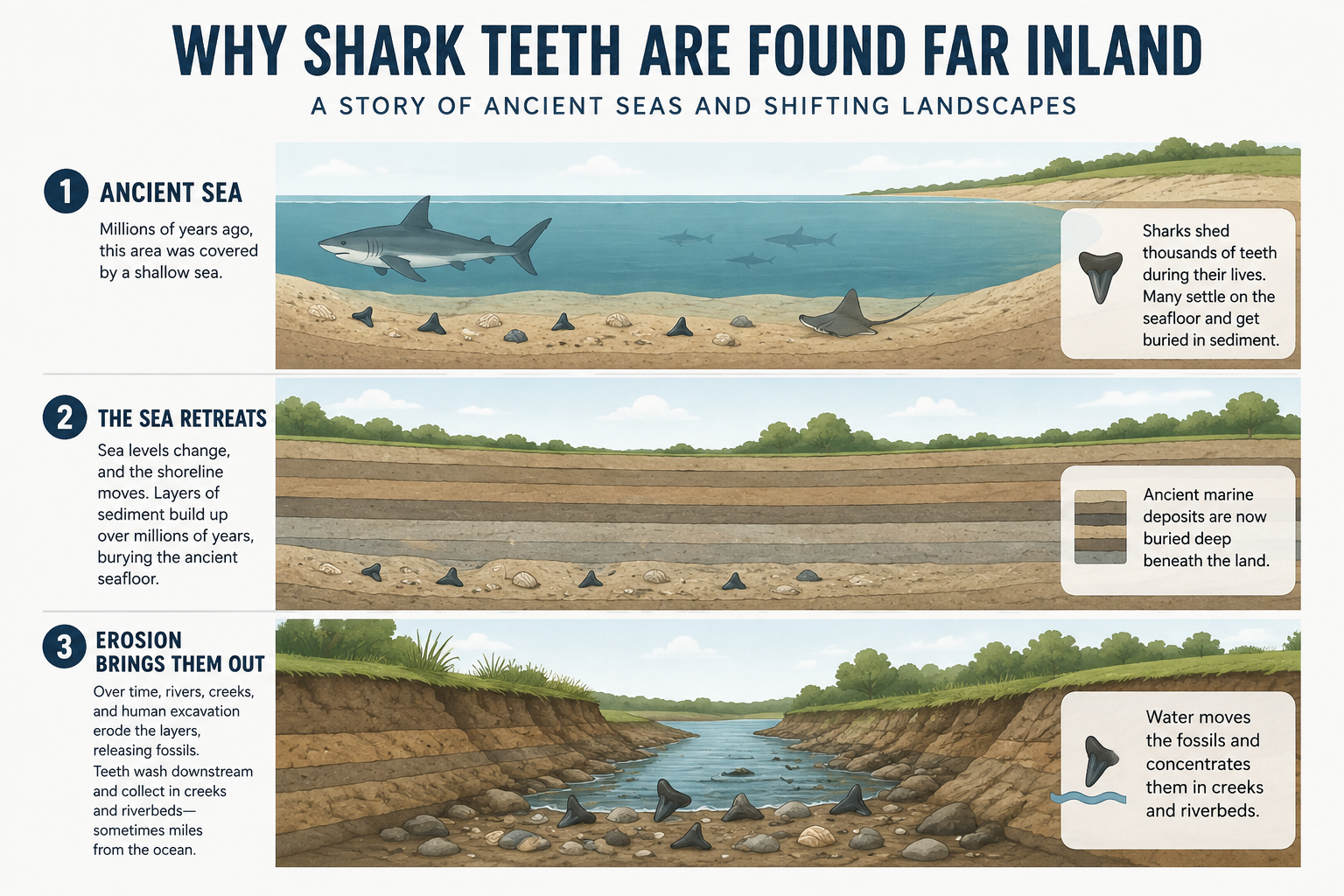
You don't have to be standing on a South Carolina beach to find a shark tooth. Fossil teeth regularly turn up miles inland in creeks, riverbanks, drainage ditches, and freshly disturbed ground throughout the Coastal Plain. That might seem strange when the Atlantic Ocean is nowhere in sight.
But there's a simple explanation: The coastline hasn't always been where it is today.
Much of the Coastal Plain Was Once Underwater
Over millions of years, South Carolina's coastline has shifted dramatically as sea levels rose and fell. At various points in the state's geologic history, the Atlantic extended much farther inland than it does today.
In fact, the South Carolina Department of Natural Resources notes that the Coastal Plain was submerged for an extended period of geologic history before fluctuating sea levels repeatedly moved the shoreline across the region.
Those ancient waters were home to sharks and other marine animals. Sharks continually shed and replaced their teeth, and some of those teeth became buried in sediment on the seafloor. Over time, minerals replaced or filled portions of the original tooth material, allowing the teeth to survive as fossils for millions of years.
When the sea eventually retreated, those marine sediments didn't disappear. They became part of the land beneath modern South Carolina.
That's why finding a shark tooth 20, 30, or even more miles from today's coastline doesn't necessarily mean the tooth somehow traveled there from the modern ocean. It may have originated in marine sediments deposited when that area was underwater.
Ancient Marine Layers ARe Still Beneath the Lowcountry
The Charleston area is particularly well suited for inland fossil hunting because ancient marine formations lie beneath much of the region.
Two formations that fossil hunters around Summerville and Charleston may encounter are the Ashley Formation and Chandler Bridge Formation, both deposited during the Oligocene Epoch more than 20 million years ago.
The Ashley Formation formed in a marine environment and contains fossils of sharks, rays, fish, whales and other marine animals. Above it, the younger Chandler Bridge Formation contains phosphate-rich sands and is particularly well known for its abundant marine vertebrate fossils.
Today, these ancient deposits are often buried beneath much younger sediments. Where erosion, creeks, rivers or excavation cut into fossil-bearing layers, fossils that have remained underground for millions of years can be exposed.
So Why Are Shark Teeth Sitting in Creeks?
This is where erosion comes into the picture.
Many fossil-bearing layers are buried beneath younger sediment. Creeks and rivers gradually cut through those layers, exposing material that may have been underground for millions of years.
Once a fossil erodes out, flowing water can move it away from its original location. Smaller and lighter sediment is often carried farther downstream, while heavier material can become concentrated in certain areas.
That's why shark teeth are often found mixed with phosphate pebbles, rocks, shell fragments and other coarse material in Lowcountry creek and river beds.
Some teeth may have been reworked more than once. A fossil can erode out of one ancient deposit, be transported by water, become buried again in younger sediment, and eventually be exposed by erosion a second time.
Construction, ditch digging and other ground disturbance can also expose fossil-bearing sediments that would otherwise remain underground.
A Reminder of a Very Different South CArolina
Finding a shark tooth inland is more than just finding something a shark lost millions of years ago. It's evidence of how dramatically South Carolina's landscape has changed.
The quiet creek running through the woods today may be cutting through sediments that accumulated when the region looked nothing like it does now.
So when you find a fossil shark tooth miles from the Atlantic, the most interesting question might not be “How did this tooth get so far from the ocean?” It's “How did the ocean get so far from this tooth?”