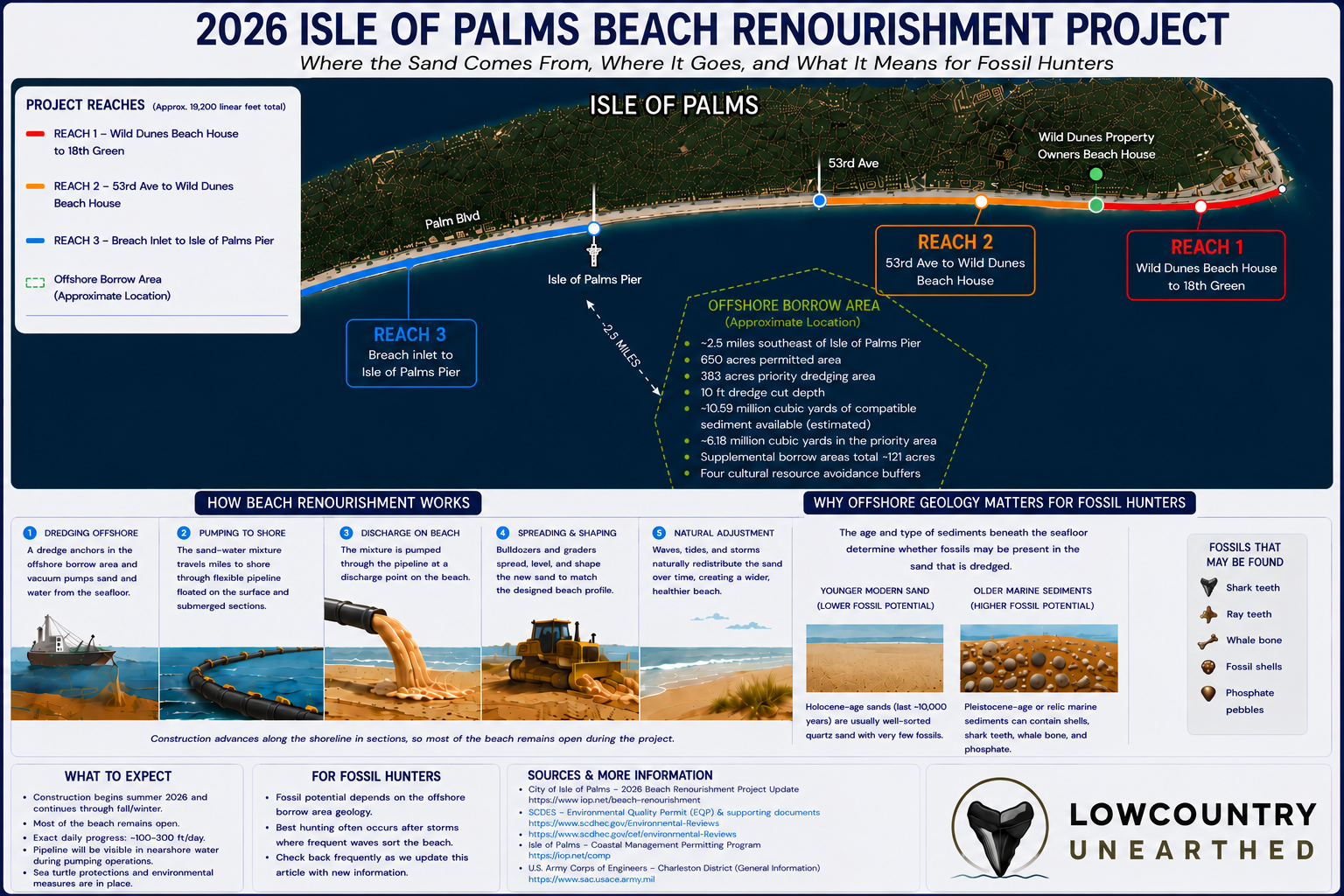
Every few years, heavy waves, tides, storms, and hurricanes gradually erode the beaches of Isle of Palms. To protect homes, infrastructure, wildlife habitat, and one of South Carolina's most popular beaches, the City periodically undertakes large-scale beach renourishment projects. The 2026 Isle of Palms Beach Renourishment Project is one of the largest in recent years, placing approximately 2.5 million cubic yards of sand onto nearly 3.6 miles of shoreline. While the project is primarily designed to restore the beach and improve storm protection, many fossil hunters are asking a different question: Will the new sand bring more shark teeth to Isle of Palms? The answer isn't as straightforward as you might think.
Why Does Isle of Palms Need Beach Renourishment?
Beaches are constantly changing. Every tide, storm, and wave moves sand up and down the shoreline. Over time, Isle of Palms naturally loses sand through erosion, especially after tropical storms and hurricanes. Beach renourishment restores some of that lost sand by pumping compatible sand from offshore borrow areas back onto the beach. The wider beach helps: Reduce erosion, Improve hurricane protection, Protect roads and oceanfront properties, Maintain sea turtle nesting habitats, Preserve recreational beach access, and Reduces long-term storm damage. Rather than building seawalls (which often increase erosion elsewhere) South Carolina generally relies on periodic beach nourishment as its preferred coastal management strategy.
Where Is the Sand Coming From?
Unlike some previous projects that reused material dredged from nearby waterways, the 2026 project will obtain sand from a large offshore borrow area approximately 2.5 miles southeast of the Isle of Palms Pier. Before any dredging begins, engineers spend years studying the offshore seafloor to locate deposits whose grain size closely matches the native beach. Matching the existing sand is important because sand that is too fine washes away quickly, while sand that is too coarse can permanently change the character of the beach. The permitted borrow area encompasses approximately 650 acres, with the primary excavation area covering roughly 383 acres. Dredging is limited to approximately 10 feet below the existing seafloor, and engineers estimate the borrow area contains more than 10 million cubic yards of beach-compatible sediment—far more than is needed for this project. While the technical sediment investigations were not published alongside the City's public project information, Lowcountry Unearthed obtained the geotechnical reports through a South Carolina Freedom of Information Act request. Those reports include vibracore logs, grain-size analyses, and sediment statistics that provide a much clearer picture of the offshore borrow area and help us better evaluate what fossil hunters might realistically expect after nourishment.
Where Will the New Sand Be Placed?
The project will restore approximately 19,200 linear feet (about 3.6 miles) of shoreline.
Construction will occur in three primary reaches:
• Northern Wild Dunes, beginning near Ocean Point and extending through Mariner's Walk toward Ocean Club.
• Central Wild Dunes, including Ocean Club, Beach Club, and Grand Pavilion
• Southern Isle of Palms, beginning near the public beach area and Isle of Palms County Park before extending south toward Breach Inlet
Construction is expected to progress roughly 100–250 feet per day, placing approximately 25,000–30,000 cubic yards of sand each day. Because construction advances gradually, most of the beach remains accessible throughout the project.
How Does Beach Renourishment Work?
The process begins offshore. A specialized dredge anchors within the approved borrow area and pumps a mixture of sand and seawater through miles of floating and submerged pipeline to the beach. Once the slurry reaches shore: bulldozers spread the sand, graders shape the new beach, and heavy equipment restores the designed beach profile. As construction moves along the shoreline, sections behind the work area reopen while the pipeline advances to the next section.
What About Sea Turtles?
Sea turtle nesting season overlaps with much of the construction schedule, so beach renourishment projects must follow strict environmental requirements. Typical measures include: biological monitoring, nest relocation when necessary, lighting restrictions, equipment operating procedures, and post-construction beach tilling if required. These measures help minimize impacts on nesting sea turtles while allowing the project to proceed.
Will the Beach Close?
No. Temporary construction zones will move with the project, but the vast majority of Isle of Palms Beach will remain open throughout construction. Visitors may occasionally need to walk around active work areas or use alternate beach access points while equipment is operating.
Will Beach Renourishment Bring More Shark Teeth?
The answer depends almost entirely on the geology of the offshore borrow area. Not all offshore sand is the same. Some borrow areas consist almost entirely of clean, modern quartz sand, while others contain a mixture of shell-rich and coarser marine sediments with the potential to contain fossil material. Whether those materials ultimately reach the beach depends on the composition of the seafloor and the depth of dredging.
Update (July 2026): Since this article was first published, Lowcountry Unearthed obtained and reviewed the project's geotechnical report, vibracore logs, grain-size analyses, and permit documents through a South Carolina Freedom of Information Act request, and the results paint a much clearer picture of the offshore borrow area. Rather than a uniform deposit of clean sand, the vibracores reveal changing sediment textures, shell-rich intervals, coarse shell fragments, and occasional mud lenses. Several intervals contain exceptionally high shell content, with some samples exceeding 30% shell material and one interval exceeding 60% shell fragments. While the reports do not identify the kinds of sediment layers that typically produce exceptionally high concentrations of fossils in South Carolina, they do reveal shell-rich and coarser marine sediments rather than a simple blanket of modern beach sand, suggesting the borrow area has greater fossil potential than initially expected.
Based on the available geotechnical data, we believe the 2026 Isle of Palms renourishment has moderate fossil potential. We do not expect this project to transform Isle of Palms into one of South Carolina's premier fossil beaches overnight. However, the shell-rich and coarser sediment layers documented in the borrow area increase the likelihood that scattered shark teeth and other marine fossils will become incorporated into the nourishment sand. As with most nourishment projects, the best hunting will likely occur after months of wave action and especially following storms, when lighter sand is removed and heavier material becomes naturally concentrated along the beach.
When Should Fossil Hunters Look?
If offshore fossil-bearing material is present, newly placed sand usually does not produce the best hunting immediately. Instead, storms often remove lighter sand first, leaving heavier materials such as: shells, shark teeth, and other fossils concentrated along the beach. For that reason, the weeks and months following often provide the best opportunities after a nourishment project, especially after storms.
Does Beach Renourishment Always Improve Fossil Hunting?
No. In fact, many nourishment projects initially bury productive shell layers beneath several feet of clean sand (think Folly Beach the last couple of years). Whether hunting ultimately improves depends entirely on the geology of the offshore borrow area. Projects using navigation channel dredging or tidal inlet sediments often contain more fossil material than projects that excavate only modern offshore sand. Because the 2026 Isle of Palms project uses a designated offshore borrow area rather than inlet dredging, the fossil potential remains uncertain until additional geological information becomes available.
Final Thoughts
The 2026 Isle of Palms Beach Renourishment Project represents a major investment in protecting South Carolina's coastline from erosion and future storms. For beachgoers, it means a wider, healthier beach. For engineers, it's a carefully planned coastal restoration effort. For fossil hunters, however, it raises a fascinating geological question. Will millions of cubic yards of offshore sand carry with them traces of South Carolina's prehistoric past? The answer lies beneath the seafloor and we're working to uncover it. For more information on shark tooth & fossil hunting on South Carolina beaches, check out our fossil hunting locations page!