
The fossils found across the Lowcountry region, from inland areas to coastal beaches and river systems, are the result of millions of years of shifting sea levels, ancient marine environments, and sediment deposition across the Atlantic Coastal Plain. As prehistoric oceans advanced and retreated, they left behind fossil-rich layers that were buried inland and later re-exposed. And Summerville, South Carolina has a unique story to tell, so lets dig in.
Why Are There So Many Fossils in South Carolina?
If you've ever walked a creek in Summerville and found a shark tooth, you've probably wondered: How did marine fossils end up more than 20 miles from the ocean? The answer begins long before there was a Summerville, long before there was a Charleston, and long before humans ever set foot in South Carolina. This story starts roughly 37 million years ago.
When South Carolina Was Underwater
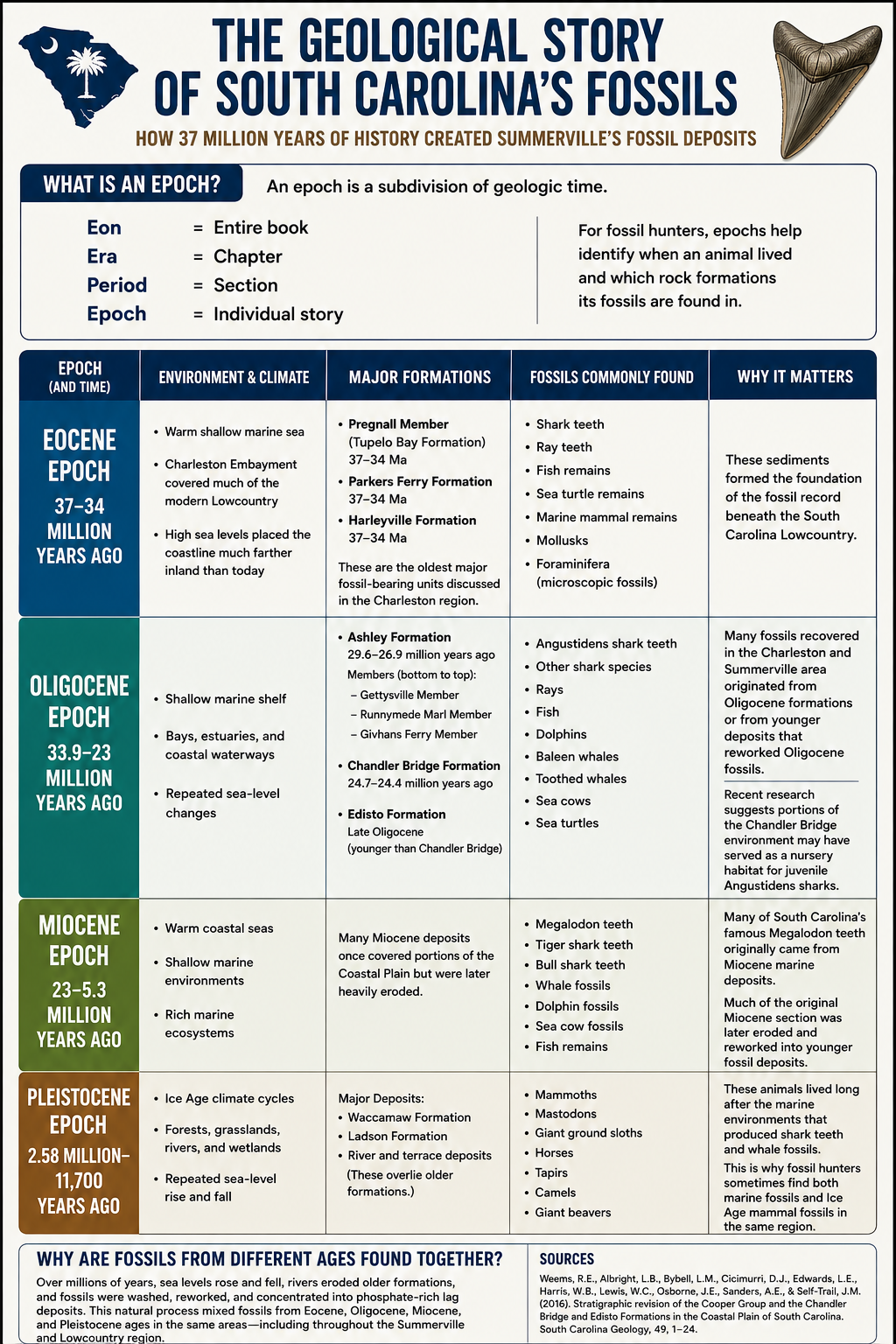
Today, the South Carolina Lowcountry is covered by forests, neighborhoods, farms, swamps, rivers, and tidal marshes. But during the late Eocene Epoch, much of the modern Coastal Plain was submerged beneath a warm sea. The shoreline was far inland compared to where it is today. Areas that are now Summerville, Charleston, Dorchester County, Berkeley County, and much of the surrounding Lowcountry were underwater. This wasn't necessarily the deep ocean that many people imagine. Instead, the region was part of a broad marine basin known as the Charleston Embayment, where marine sediments accumulated over millions of years. The waters were home to sharks, rays, fish, sea turtles, marine mammals, and countless microscopic organisms called foraminifera. When these organisms died, their remains settled onto the seafloor. Over time, these sediments built thick layers of limestone, marl, and calcareous sands that still lie beneath the Lowcountry today.
The First Fossil-Bearing Layers
The oldest major fossil-bearing units beneath the Summerville area belong to the late Eocene. These include the Tupelo Bay Formation, Parkers Ferry Formation, and Harleyville Formation. These formations preserve a snapshot of life that existed in South Carolina roughly 37 to 34 million years ago. Most of these deposits remain buried beneath younger deposits, but they are exposed in a few quarries near Harleyville, South Carolina. Some of the most important fossil discoveries from South Carolina's Eocene deposits have come from these exposures. Whale remains, sharks, rays, fish, sea turtles, mollusks, and microscopic marine fossils have all been recovered from these units.
A World Begins to Change
Near the end of the Eocene, Earth's climate began cooling significantly. Large ice sheets formed in Antarctica, and as more water became locked up in ice, global sea levels fell, coastlines shifted, and marine habitats changed. Scientists refer to this period as the Eocene-Oligocene Transition, one of the most significant climate changes in Earth's history. In South Carolina, these changes are recorded directly in the rock layers beneath our feet.
The Ashley Sea
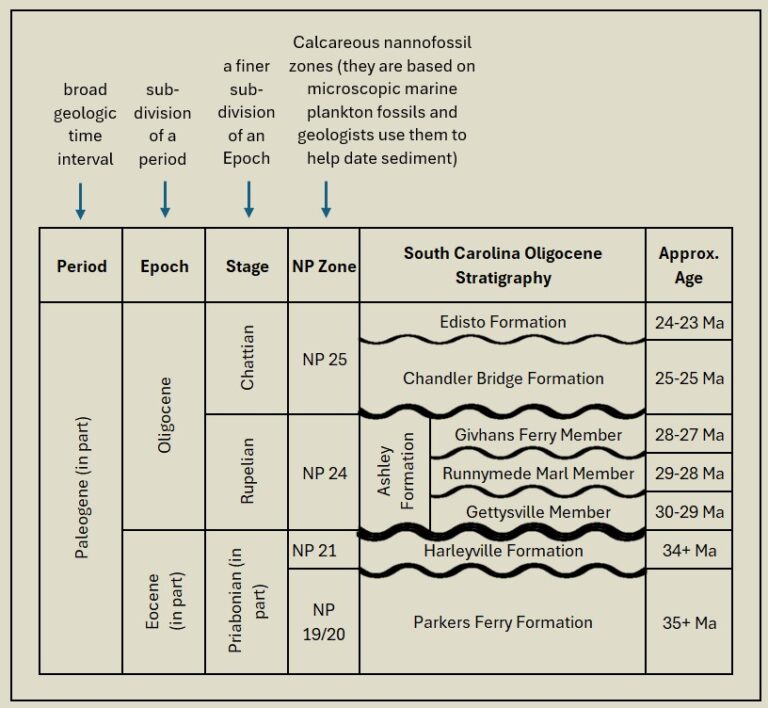
By the early Oligocene, roughly 29 million years ago, the sea still covered much of the Charleston region. Sediments deposited during this time formed what geologists call the Ashley Formation. For fossil hunters, the Ashley Formation is one of the most important units in South Carolina. What many people don't realize is the Ashley Formation wasn't deposited all at once. Geologists have divided it into three distinct layers known as the Gettysville Member, the Runnymede Marl Member, and the Givhans Ferry Member. Each records a slightly different chapter in the history of the ancient Ashley Sea, and each is separated by thin phosphate-rich lag deposits containing worn shells, shark teeth, bones, and other fossils. Many fossils recovered in the Charleston and Summerville area can be traced to the Ashley Formation or to deposits derived from it. It preserves evidence of a rich marine ecosystem that included sharks, rays, bony fish, sea turtles, dolphins, toothed whales, baleen whales, sea birds, and numerous invertebrates. The Ashley Formation is especially important because it is one of the best-preserved Oligocene marine units on the Atlantic Coastal Plain.
The Chandler Bridge Environment
Around 25 to 24 million years ago, conditions changed again. Sediments that would later become the Chandler Bridge Formation began accumulating across parts of the region. Unlike many older marine deposits, the Chandler Bridge Formation represents shallower coastal environments that included bays, estuaries, tidal channels, and protected nearshore waters. The Chandler Bridge Formation has produced an extraordinary variety of fossils including Shark teeth, Ray teeth, Fish remains, Sea turtles, Dolphins, Baleen whales, Toothed whales, and Sea cows. One of the most remarkable discoveries tied to the Chandler Bridge Formation came when researchers noticed something unusual while studying thousands of Otodus angustidens: juvenile teeth vastly outnumbered adult teeth. This pattern closely mirrors what scientists see in modern shark nursery habitats, where young sharks spend their early years in protected coastal waters before moving into deeper environments. Based on this evidence, researchers concluded that portions of the ancient Charleston Embayment likely served as a nursery ground for the giant megatoothed shark Otodus angustidens. In other words, the shallow waters of the South Carolina Lowcountry may have once been a safe haven for young sharks that would eventually grow into some of the largest predators of their time. Whether you're holding a small angustidens tooth or a large one, there's a good chance it originated from an ecosystem that once existed right here in the Lowcountry.
The Arrival of Megalodon
During the Miocene Epoch, roughly 23 to 5 million years ago, marine environments continued to occupy portions of the South Carolina Coastal Plain during periods of higher sea level. Fossils from Miocene deposits include Megalodon, tiger sharks, dolphins, whales, sea cows, and numerous fish species. Many of the Megalodon teeth recovered throughout South Carolina originated from these Miocene marine sediments, although much of the original Miocene section has since been eroded and reworked into younger deposits.
The Great Erosion
For millions of years, sea levels repeatedly rose and fell across South Carolina, and each change reshaped the landscape. As sea levels fell, rivers cut into older formations. As sea levels rose again, new sediments were deposited. This resulted in older fossil-bearing layers becoming exposed and eroded. Fossils that had been buried for millions of years were released from their original formations. Shark teeth, whale bones, turtle shell fragments, fish vertebrae, and countless other fossils were carried by water and redeposited elsewhere in a process known as “reworking”. A fossil originally buried in one formation could be eroded out and redeposited into a much younger sediment layer. As a result, fossils of different ages became mixed together.
The Formation of Fossil Lag Deposits
As erosion removed enormous amounts of sediment, the lighter material was carried away while heavier and more durable material remained behind. Items such as: shark teeth, whale bones, dense bone fragments, turtle shell, fish teeth, phosphate nodules became concentrated into what geologists call lag deposits. Over time, these lag deposits accumulated fossils from multiple formations and multiple periods of geologic history. Some lag deposits contain fossils that originally came from layers separated by millions of years. And this is very much characteristic of the Summerville area.
The Ice Age Adds Another Chapter
During the Ice Age, sea levels rose and fell repeatedly as glaciers expanded and melted. These cycles caused rivers to cut even deeper into older formations. At the same time, large land mammals inhabited the Coastal Plain such as mastodons, giant sloths, horses, tapirs, camels, and giant beavers left behind fossils that eventually became part of the region's fossil record.This is why fossil hunters in South Carolina can sometimes find marine fossils and Ice Age mammal fossils within the same general area.
Why Summerville Is So Fossil Rich & Why Enthusiasts Travel Here to Unearth Them
Summerville did not become famous because of a single fossil layer. It became famous because it sits near an area where fossils from multiple formations and multiple ages were concentrated through erosion and reworking. Over millions of years, fossils from Eocene, Oligocene, Miocene, Pliocene, and Pleistocene deposits became mixed into lag deposits throughout parts of the Lowcountry. Creeks, rivers, drainage ditches, construction sites, and natural erosion continue exposing these deposits today. Every major rainstorm has the potential to uncover fossils that have been hidden for millions of years, and that is why collectors continue making remarkable discoveries in the Summerville area generation after generation.Very few places in North America offer access to such a wide range of fossil ages within such a small geographic area. A single day of fossil hunting in the Lowcountry can potentially uncover evidence of ancient Eocene seas, Oligocene marine ecosystems, giant megatoothed sharks, early whales and dolphins, miocene coastal environments, and Ice Age mammals. Every fossil tells part of that story, and every creek in the Lowcountry is a reminder that the landscape we see today is only the latest chapter in a history that stretches back tens of millions of years.
If you are interested in reviewing the formation exposure landscape across the low country, a great place to start would be the U.S. Geological Survey Maps. The USGS has a fantastic repository of Maps, including descriptions of formation layers as well as which layers are exposed where across the Lowcountry!